
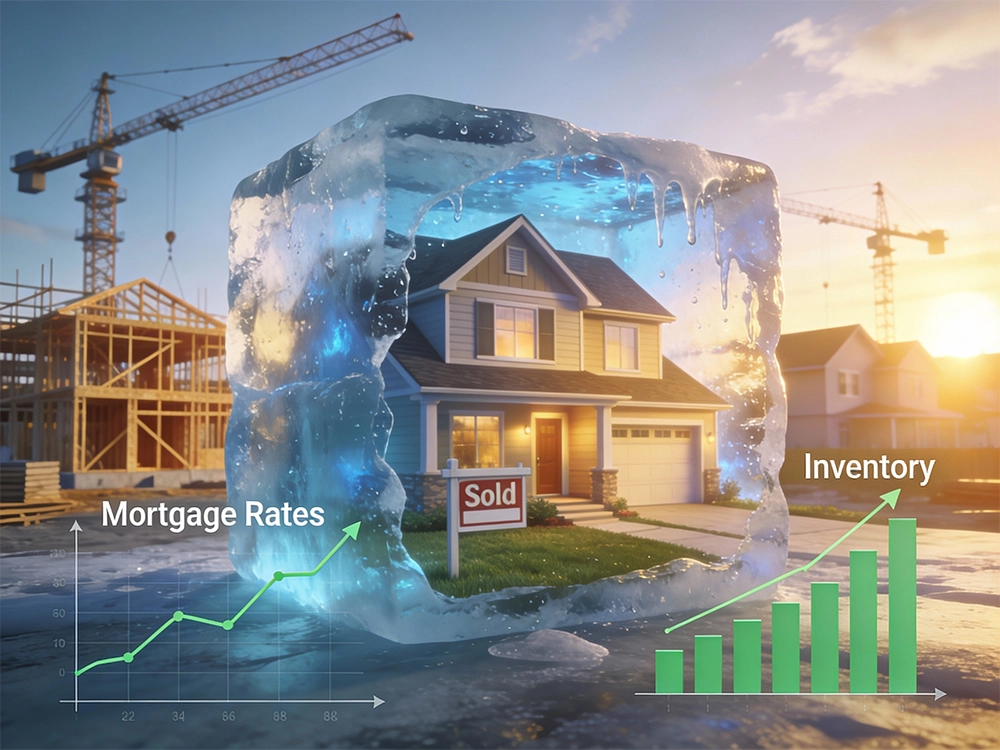
After years of frozen inventory and bidding wars, the U.S. housing market is finally showing signs of normalization. The notorious “lock-in effect”—where homeowners with sub-3% mortgage rates refused to sell—is beginning to crack as life events force movement and mortgage rates stabilize. For the first time since the pandemic, buyers are regaining negotiating power, inventory is climbing, and the dream of homeownership is becoming tangible again.
The Great Unlock: 14% More Home Sales Expected
The National Association of Realtors (NAR) is forecasting a 14% increase in home sales nationwide in 2026, marking a decisive break from the stagnant 4 million annual sales floor that has defined the past two years. This surge is driven by two converging forces: the steady disappearance of the lock-in effect and improved mortgage rate conditions.
Lawrence Yun, NAR’s Chief Economist, notes that life-changing events—marriages, divorces, job relocations, and downsizing retirements—are compelling even rate-locked homeowners to list their properties. The psychological grip of the 2.5% mortgage is loosening as reality sets in: holding onto a home that no longer fits your life isn’t worth the savings on monthly payments.
Inventory levels are now 20% higher than a year ago, giving buyers meaningful choices for the first time since 2020. While still below pre-COVID norms, this represents a critical shift from the seller-dominated frenzy where multiple offers and waived contingencies were the price of entry. Today’s market is balanced—buyers aren’t rushing, and sellers are learning to negotiate.
Mortgage Rates: The 6% Threshold and the Buyer Pool Explosion
The most transformative variable for 2026 is the trajectory of mortgage rates. After peaking above 7% in 2023 and hovering in the high 6% range throughout 2025, rates are expected to stabilize around 6.3% in 2026, with potential dips below 6% if the Federal Reserve continues its easing cycle.
This seemingly modest decline has profound implications. According to NAR analysis, a one percentage-point drop in mortgage rates expands the pool of qualified buyers by approximately 5.5 million households, including 1.6 million renters who could transition to first-time homeownership. While not all will purchase, historical patterns suggest about 10% will act—translating to roughly 500,000 additional home sales in 2026.
For perspective: the difference between a 7% and a 6% mortgage on a $400,000 home is approximately $250 per month, or $3,000 annually. For middle-income buyers stretched thin by inflation, this is the difference between qualifying and being priced out.
Price Moderation: The First Real Decline Since 2020
One of the most significant—and underreported—trends for 2026 is the expectation of declining monthly payments. After years of relentless increases, the combination of stabilizing mortgage rates and modest home price growth (projected at 2-3%) means that for the first time since 2020, the typical buyer’s monthly payment will actually decrease.
Home prices are not collapsing; they’re simply growing at or slightly below the rate of overall consumer inflation. Danielle Hale, chief economist at realtor.com, emphasizes that in real terms, home prices are declining relative to other goods and services, meaning housing is becoming more affordable even if sticker prices don’t fall. Coupled with wage growth outpacing inflation, purchasing power is slowly returning to American households.
However, this improvement is not uniform. Middle-income buyers—the backbone of the housing market—can currently afford only 21% of available homes, compared to 50% before the pandemic. This stark disparity underscores why targeted supply, particularly in the affordable and entry-level segments, remains critical.
The Builder Advantage: New Homes Cheaper Than Resales
In an unprecedented market anomaly, the median price of a newly built home is now lower than the median resale home price—a reversal that has occurred only two or three times in the past several decades. This shift is driven by aggressive builder incentives, including price cuts, mortgage rate buydowns, and the geographic concentration of new construction in more affordable Sun Belt and Midwest markets.
Robert Dietz, chief economist for the National Association of Home Builders, notes that single-family home construction is expected to grow by about 1% in 2026, supported by Federal Reserve rate cuts that directly reduce construction and development loan costs. While this growth is modest, it’s a critical step toward addressing the structural housing deficit that continues to constrain long-term affordability.
The geographic winners in 2026 are not the traditional boomtowns of Texas and Florida, which are experiencing cyclical slowdowns after years of overbuilding. Instead, Midwest markets like Columbus, Indianapolis, and Kansas City—long-affordable cities near major universities and employers—are showing outsized growth.
Demographic Shifts: Baby Boomers Still Dominate
The buyer profile in 2026 looks markedly different from historical norms. Baby boomers, armed with significant housing equity, remain the dominant force, accounting for a disproportionate share of all-cash purchases. These retirees are making lifestyle moves—downsizing, relocating near family, or upgrading to retirement destinations—without the constraints of mortgage financing.
Conversely, first-time buyers are slowly re-entering the market but remain underrepresented. Jessica Lautz, NAR’s deputy chief economist, highlights another emerging trend: single female buyers are growing as a force in the market, reflecting lower marriage and birth rates. The traditional nuclear family with children now represents only a quarter of buyers, signaling a long-term shift toward smaller households and different housing preferences.
The Road Ahead: Balance, Not Boom
The housing market of 2026 is not returning to the frothy speculation of 2020-2021. What is emerging is balance: buyers have choices, sellers must be realistic, and affordability—while still challenging—is improving. The “lock-in effect” is fading not because rates have returned to 3%, but because life moves on, and the market is adapting.
For buyers, 2026 offers the best entry point in years. For sellers, it’s a market that rewards patience and pricing discipline. And for the industry, it’s a reminder that sustainable growth—not hyperbolic boom cycles—builds lasting wealth.