
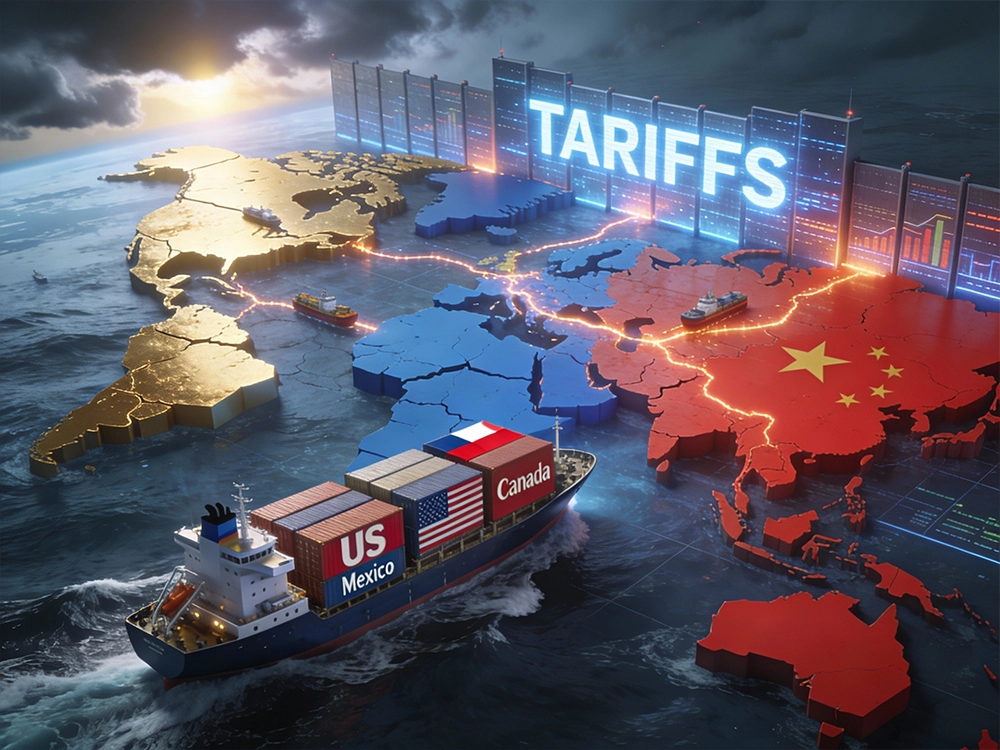
As 2026 unfolds, the global economy is grappling with the most significant restructuring of trade relations since the post-World War II era. President Donald Trump’s administration, re-elected on a platform of “industrial sovereignty,” has moved aggressively from rhetoric to implementation. With universal baseline tariffs now a reality and targeted levies hitting specific nations, multinational corporations are engaged in a high-stakes scramble to immunize their supply chains against the new protectionist paradigm.
The New Tariff Map: “Liberation Day” and Beyond
The turning point came on April 2, 2025, dubbed “Liberation Day” by the administration, when a blanket 10% universal tariff was announced alongside targeted duties reaching as high as 49% for specific nations. By January 2026, the landscape has hardened:
China: Facing tariffs of up to 34% (on top of previous levies), Chinese imports to the U.S. have plummeted, continuing a downward trend that saw a 17% drop in 2025.
European Union: Tensions remain high as the U.S. threatens a 30% tariff on EU goods. While negotiations are ongoing with an August deadline, European leaders like Ursula von der Leyen are preparing “countermeasures” to protect the bloc’s export-heavy economy.
Vietnam & Southeast Asia: Once seen as safe havens, countries like Vietnam (46%) and Thailand are now in the crosshairs, penalized for their massive trade surpluses with the U.S..
This “tariff pileup” has shattered the illusion that moving production out of China alone is sufficient. In 2026, the question is no longer just “Is it made in China?” but “Is it made in a friend-shored nation with a stable trade deal?”
Supply Chain Response: The Rise of “Fortress North America”
The most immediate beneficiary of Trade Wars 2.0 is the North American trading bloc. Despite friction over the USMCA renegotiation, Mexico and Canada remain the safest bets for U.S.-bound supply chains.
Mexico’s Industrial Boom: Mexico has cemented its status as the primary nearshoring winner, capturing market share lost by China. Industrial space in Mexico is growing by 65 million square feet annually to accommodate automotive, aerospace, and electronics manufacturers fleeing Asian tariffs.
USMCA Outlook: Analysts expect the USMCA to be renewed by Q2 2026. While stricter rules of origin may increase compliance costs, the agreement effectively creates a “Fortress North America,” shielding member nations from the steepest global levies.
For corporations, this has triggered a massive capital pivot. Companies are abandoning the “just-in-time” efficiency model for a “just-in-case” resilience strategy, stockpiling inventory and duplicating production lines closer to the U.S. border to mitigate policy risk.
The Inflationary Aftershock
The economic cost of this restructuring is becoming visible in consumer prices. While the Federal Reserve cuts rates to stimulate growth, tariffs act as a countervailing force, keeping a floor under inflation.
Consumer Impact: Retailers, particularly in fashion and electronics, are signaling that the era of absorbing tariff costs is over. Sourcing managers entering 2026 are warning that higher duties will inevitably be passed to American consumers.
Growth Drag: Economists estimate that the friction from these tariffs could drag global GDP growth down to 2.5% in 2025-2026. The “tax” on imports is effectively a tax on consumption, dampening the purchasing power boost from recent tax cuts.
Winners and Losers in the 2026 Trade Matrix
The divergence between sectors is stark.
The Winners: Domestic steel (Nucor) and aluminum producers (Alcoa) are shielded from foreign competition, enjoying pricing power. Industrial real estate developers in Mexico and the U.S. Sun Belt are seeing record demand.
The Losers: U.S. exporters facing retaliatory tariffs, particularly in agriculture, are vulnerable. Additionally, multinational tech firms relying on complex, cross-border semiconductor supply chains face a “compliance nightmare” as they navigate the conflicting demands of U.S. export controls and foreign retaliation.
Conclusion: The End of Globalism as We Knew It
In 2026, the “Global Village” has been replaced by “Gated Communities.” The supply chain of the future is shorter, more regional, and significantly more expensive. For investors and business leaders, the message is clear: political geography now matters as much as economic efficiency. Success in this new era depends on aligning operations with the political map of “Trade Wars 2.0”—betting on North American integration while hedging against the deepening rift between the West and the Asian manufacturing hub.